
ALASKA FIELD SHOWCASE: SUBSISTENCE ACCESS & TUNDRA PROTECTION
Engineered Stability for Alaska’s Remote Frontier
In the Alaskan
interior and coastal regions, trail degradation in wet, unstable, and
sensitive environments requires more than just a temporary fix.
It requires
Trail Hardening:
the engineering of a stable "wear and carry" surface that prevents trail
braiding and protects the underlying soil and permafrost.
THE GOLD STANDARD: WHY RIGID SYSTEMS PREVAIL
Foundational research by Kevin Meyer (NPS) and Kevin Keeler (BLM) in the landmark study "Managing Degraded OHV Trails in Wet, Unstable, and Sensitive Environments" established that Structural Integrity requires a Rigid Bridge.
The Risk of "Mechanical Zippering"
Modern field observations across rural Alaska have identified a specific failure known as "zippering" in lightweight, peg-and-hole grid systems.
-
The Failure: Under the high-torque acceleration of heavily loaded subsistence ATVs, lightweight connectors snap or uncouple.
-
The Result: The trail "unzips," leading to heaving, overlapping units, and eventual burial in the muck.
-
The GeoCHEM Solution: We exclusively recommend GeoTerra® Structural Re-vegetative Mats & GeoBlock® 5150 Porous Pavers and because their tabular interlocking, bolt-and-cam or Padloc® connections create a monolithic, unyielding structural bridge that is specifically engineered to resist uncoupling.
FEATURED ALASKA PROJECT SHOWCASES
1. Nelson Island Subsistence Trail System (Tununak – Toksook Bay – Nightmute)
-
The Project: A massive inter-village connection spanning Nelson Island to provide safe subsistence access and medical transit between communities.
-
The Scope: Includes the 26-mile GeoTerra® installation connecting Tunuanak to Toksook Bay and Nightmute.
-
Technical Solution: GeoTerra® Structural Mats were selected to "float" over the high-saturation tundra.
-
Connectivity: This system links Tununak, Toksook Bay, and Nightmute, ensuring residents have reliable access to hunting grounds and the regional health clinic regardless of seasonal thaw conditions.
2. Palmer Hay Flats State Game Refuge (Cottonwood Creek)

-
The Challenge: High-traffic hunting access in coastal wetlands north of Anchorage.
The Solution:
800 feet of
GeoBlock®
installed in 2000, with a 400-foot extension added in 2013.


3. Hooper Bay "T-Road" Pilot (Sea Lion Corp / Denali Commission)
-
The Challenge: Establishing "Mini-Road" standards for rural villages where gravel is scarce or cost-prohibitive.
-
The Solution: Implementation of the "T-Road" cookbook standard utilizing GeoBlock® as a structural wear surface.
-
Impact: This project earned national awards for protecting the tundra from vehicle damage while providing a durable transportation route for the community.

The Denali
Commission met Dec 12, 2007 to review the Rural Road project nominations,
including the Hooper Bay nomination.
The Hooper Bay project was selected. The Denali Commission will work with
Federal Highway and NRCS engineers to try to develop a
TRoad cook-book with ATV mini road (Troad) standards accepted for
construction projects and access to federal highway funding to do so.

4. Wrangell-St. Elias National Park & Preserve

-
The Challenge: America’s largest national park required a solution for ORV trails used by local residents for hunting, fishing, and berry-picking.
-
The Solution: Targeted application of GeoBlock® to repair degraded segments of the 66-mile ORV route system, halting the widening of trails that had grown "wider than a football field."
5. Bethel Geoblock Porous
Pavement System Demo Application


The Alaska NPS Rivers, Trails and Conservation Assistance Program helped to coordinate an ATV Trail Hardening Demonstration Project in Bethel. The NPS does not endorse other agencies or organizations, their views, products or services - Pictures with Permission from NPS.
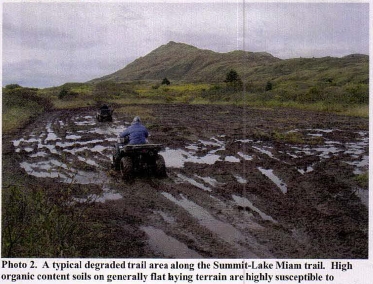
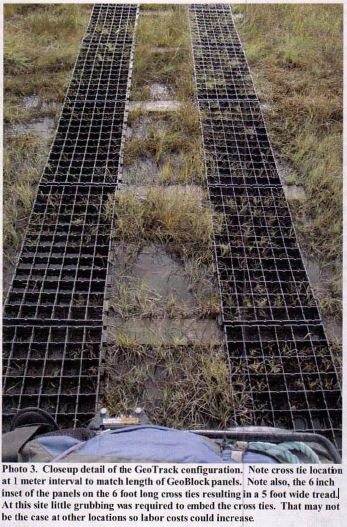
6. Summit Lake ReRoute and Trail Hardening
Summit-Lake Miam Re-Route and Trail Hardening Project Summary 2004-2005
7. Nome Alaska Geoblock Porous Pavement System Application Slideshow Presentation
-
Slideshow Pictures of a Geoblock Trail Hardening Stewart River Project North of Nome Alaska: http://www.geocheminc.com/suulutaaq.htm
8.
Kuicuaq Slough Subsistence Trail
(Village of Kwigillingok / "Kwig")
Tales from the Tundra
-
The Project: A critical transportation link from the village of Kwigillingok to the confluence of two streams, providing year-round access to key fishing and hunting areas.
-
The Scope: In cooperation with the Western Federal Lands Highway Division (WFLHD), this half-mile trail was hardened using GeoTerra® Structural Mats to prevent the severe erosion and tundra damage caused by summer ATV traffic.
-
Technical Solution: The mat system was placed directly on the tundra surface with zero excavation. To manage the extreme seasonal temperature swings, 2-inch expansion gaps were engineered between 50-foot sections—a precursor to the modern "Smith Gap" protocol.
-
Performance Benchmark: During technical verification, the trail was subjected to "extreme abuse" testing, including more than 50 passes of ATVs pulling 1,000lb+ trailers. The GeoTerra system showed no significant wear or displacement, proving its ability to maintain a "floating" structural grade over saturated wetlands.
TECHNICAL RESOURCE & FIELD DOCUMENTATION
Access the documentation established by the pioneers of Alaskan Trail Hardening.
-
[Download] Meyer/Keeler Field Guide: Managing Degraded OHV Trails in Wet, Unstable, and Sensitive Environments.
-
[Technical Spec] GeoBlock® 5150: 2-inch Rigid Porous Paver for heavy-duty load distribution.
-
[Technical Spec] GeoTerra® Padloc: Structural matting with high-strength padloc connections for 25-mile+ spans.
-
[Technical Spec] GeoTerra® GTA: Structural matting with high-strength bolt-and-cam connections.
-
[Video] Hooper Bay Installation: Watch the T-Road standard in action.
CONSULT WITH AN ALASKA PROJECT SPECIALIST
Working with a Native Corporation, the NPS, or the BLM on a remote access project? GeoCHEM provides the technical field support required to ensure your site does not suffer from "zippering" failures.
CLICK HERE TO SUBMIT YOUR PROJECT INFORMATION FOR TECHNICAL REVIEW