
Technical Validation: Testing Percol Polymers & Slurries
Empirical Performance Data for Infrastructure Engineering
The reliability of Percol polymers is backed by decades of rigorous independent testing from the world’s most demanding transportation and research authorities. From beam-bending experiments at the university level to real-world deployment by the U.S. Department of Transportation, Percol has been proven to outperform traditional cementitious and asphaltic repair materials in bond strength, flexibility, and load-bearing capacity.
California Testing Results (CT 551)
Percol's unique elastic matrix demonstrates dramatic strength and flexural growth within the first 24 hours, conforming to stringent California Department of Transportation (Caltrans) CT 551 standards.
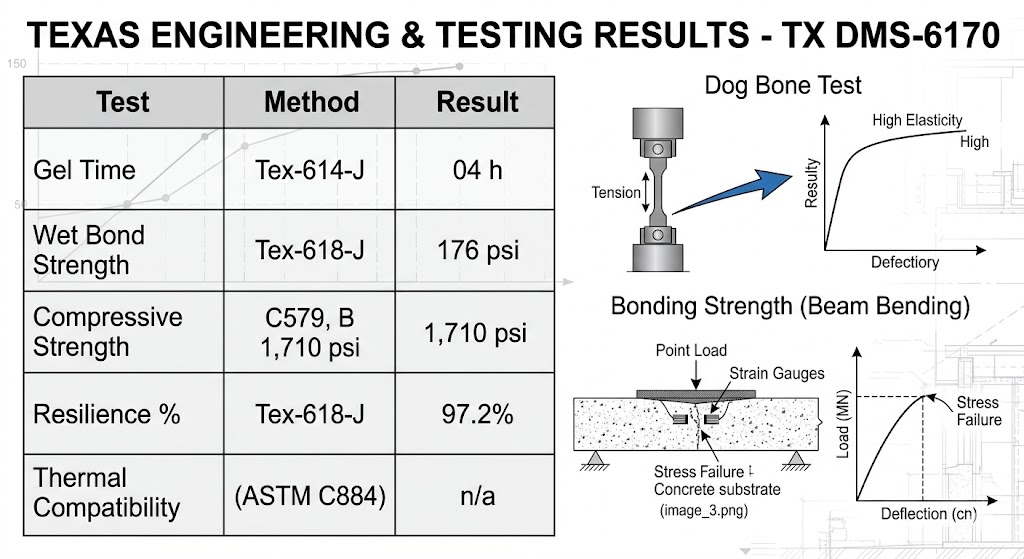
Image Description: Detailed analysis of standard physical tests for CT 551. Graph 1 confirms Compressive Strength growth—not just cure—at 1 hour, 24 hours, and 28 days. Graph 2 details high Flexural Strength (6.95 MPa) and significant Bond Strength tension (2.45 MPa) where the concrete substrate often fails before the polymer bond.
Texas Engineering & Testing Results (TX DMS-6170)
Testing conducted under Texas Department of Transportation (TxDOT) specifications confirms that Percol meets and exceeds the specific requirements for Type I Physical Requirements, demonstrating a perfect fusion of rigidity and resilience.
Image Description: Comprehensive physical validation according to TxDOT DMS-6170 Type I requirements. Key metrics include high 24hr Compressive Strength (1,710 psi), massive 97.2% Resilience, and zero delamination under ASTM C884 Thermal Compatibility (Pass).
Structural Integrity Benchmarks
The Percol Dog Bone Test
This tension test evaluates the polymer's ability to maintain a structural bond under extreme pulling force. Unlike rigid cementitious mortars which snap under sudden tensile stress, Percol’s specific polyurethane matrix allows for high elongation without sacrificing ultimate tensile strength. This provides the structural "shock absorber" required for high-vibration bridge decks and pavement interfaces.
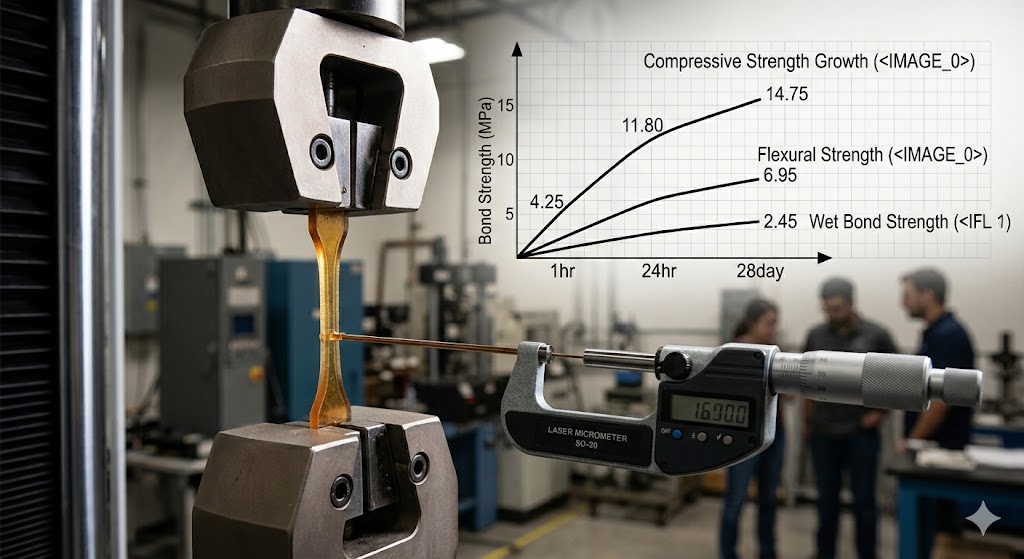
Image Description: Detailed analysis of standard physical tests for CT 551. Graph 1 confirms Compressive Strength growth—not just cure—at 1 hour, 24 hours, and 28 days. Graph 2 details high Flexural Strength (6.95 MPa) and significant Bond Strength tension (2.45 MPa) where the concrete substrate often fails before the polymer bond.
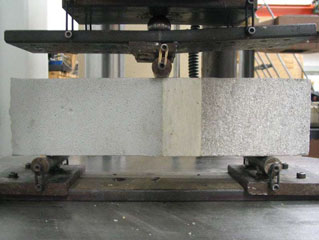
The Bonding Strength (Beam Bending) Test
By applying precise, localized pressure to a repaired concrete beam, we measure the point of failure. In most independent laboratory validations, the concrete substrate fails before the Percol bond. This proves that the chemical fusion created by Percol is technically stronger than the original concrete matrix.
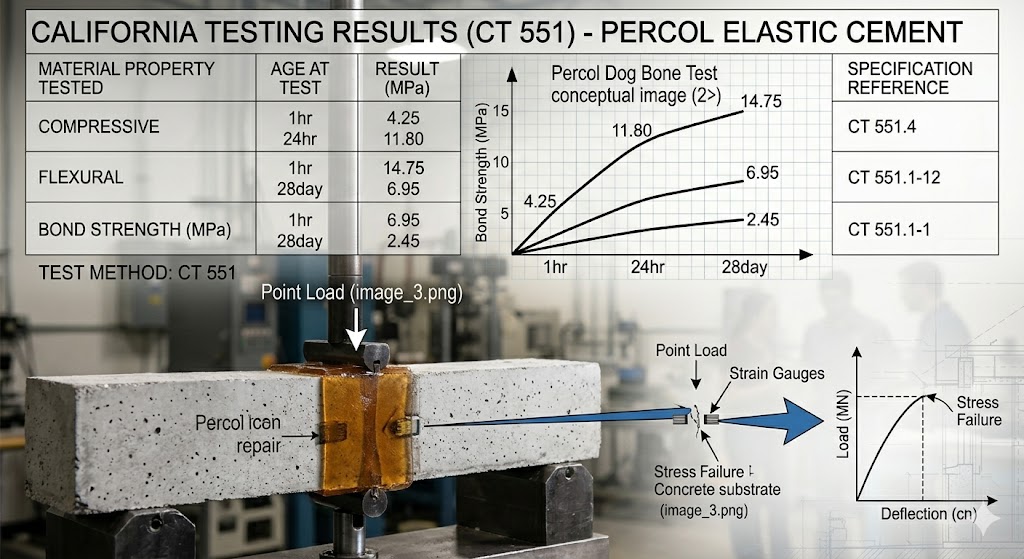
Image Description: Detailed technical validation according to CT 551 Type I. Image A details Graph 1 (Compressive Strength growth at 1hr, 24hr, 28day) and Graph 2 (Flexural Strength 6.95 MPa and significant Bond Strength tension 2.45 MPa). Image B illustrates a concrete beam repair using a point load and strain gauges to confirm failure occurs in the concrete substrate, not the Percol bond (image_1.png). Data curves match precisely (image_2.png).
Technical Resources & Project Support
The Percol Story and Testimonials
Beam Bending Experiments on Polymer Concretes and Mortar Mixes (PDF)
Evaluating Pavement Patching Materials Polymers and Elastomeric Concretes (PDF)
Percol: A Polyurethane System To Simplify Laying Of Buried Cable (PDF)

Crack Calculator, Product Calculator and Coverage Charts
Crack Calculator, Product Calculator, and Coverage Chart.
Technical Notice & Limited Warranty
Suitability of Use: Recommendations for product use are based on tests believed to be reliable. However, as field conditions vary widely, the user must determine product suitability for the particular use and specific method(s) of application.
WARRANTY & LIMITATION OF LIABILITY: The following is made in lieu of all warranties, express or implied, including implied warranties of merchantability and fitness for a particular purpose. Seller’s and manufacturer’s only obligation shall be to replace such quantity of the product proved to be defective.
NEITHER SELLER NOR MANUFACTURER SHALL BE LIABLE FOR LOSS OR DAMAGE, DIRECT, INCIDENTAL, OR CONSEQUENTIAL, REGARDLESS OF THE LEGAL THEORY ASSERTED, INCLUDING NEGLIGENCE AND/OR STRICT LIABILITY. > The foregoing may be altered only by an agreement signed by officers of the seller and manufacturer. Nothing in this data sheet is intended as a recommendation to use our products so as to infringe on any patent.


