
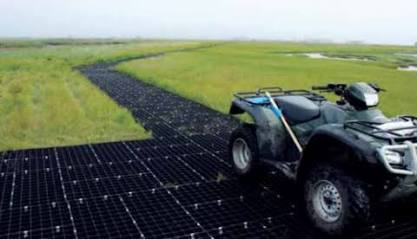
Anyone who has tried to push a loaded ATV across saturated muskeg knows the inevitable outcome: spun tires, destroyed vegetation, and a machine buried to the axles.
In remote environments, trail degradation isn’t just an environmental issue — it cuts off critical access routes. When trails fail in wet, unstable, and sensitive environments, the typical reaction is to throw down whatever fabric or gravel is available. But without understanding the mechanical forces at play, those temporary fixes simply get swallowed by the subgrade.
Permanent mitigation requires a structural approach to load distribution.
The Mechanics of Failure: Why Flexible Mats Sink
The fundamental challenge with wet subgrades (like peat, muskeg, or saturated tundra) is the lack of bearing capacity. When an ATV accelerates over these soils, the tires generate immense shear stress.
Many operators attempt to solve this by laying down lightweight roll-out matting or standard nonwoven fabrics. This is an unmitigated site design challenge common in discontinuous permafrost zones. Nonwoven fabrics are designed for filtration, not reinforcement; they stretch and deform under dynamic loads. When flexible mats deflect under the weight of a vehicle, they create a “rutting” effect. The localized pressure forces the underlying mud to pump upward, eventually unzipping the trail or burying the mat entirely.
To survive extreme freeze-thaw cycles and high-torque vehicle loads, the surface must bridge the weak soils, not conform to them.
The Rigid Solution: GeoBlock and GeoTerra
Engineered mitigation in these environments requires a rigid, interlocking surface that transforms concentrated wheel loads into a wide, shallow footprint.
Systems like GeoTerra structural mats or GeoBlock porous pavers act as an unyielding bridge over the subgrade. You can review the full mechanical profiles of these systems directly on our ATV & OHV Trail Hardening Solutions overview. Instead of the tire pushing down into the mud, the rigid matrix intercepts the load and disperses it horizontally.
- Structural Integrity: Heavy-duty mechanical connections (like Padloc® systems) ensure the mats create a monolithic surface that will not pull apart under acceleration.
- Thermal Management & Revegetation: In low-load applications, the open-cell design allows sunlight and moisture to reach the root zone, permitting natural grasses to grow up through the system, which further anchors the trail. Note: For high-load, soft-soil, or wetland applications where structural separation is required, we specify an enhanced woven geotextile sub-layer to prevent base failure and differential settlement. In these engineered scenarios, the priority is structural integrity over active revegetation.
The Critical Interface: Pairing Rigid Mats with Enhanced Woven Geotextiles
A rigid mat cannot perform indefinitely in isolation over saturated, bottomless soils. To prevent the structural surface from gradually settling under repeated heavy loads, it must be paired with an enhanced woven geotextile underlayment.
However, the underlayment cannot save the wrong type of matting. It is vital to distinguish between true base-independent structural mats (like GeoTerra and GeoBlock) and base-dependent grid systems often misused in these environments. Many rigid grids on the market are designed for applications that require a compacted, engineered subbase. Deploying base-dependent grids over highly compressible tundra—even with a high-quality woven geotextile—inevitably leads to differential settlement, as these systems lack the inherent flexural rigidity required to bridge yielding soils without a compacted subbase. Preparing an engineered base requires stripping the vegetation, which destroys the thermal insulation. In permafrost regions, this causes the frozen ground to thaw, turning your trail into a lake. The system must be capable of bridging the native soil without destructive excavation.
When the correct base-independent mat is used, neither component works without the other. The rigid matting intercepts the high-torque shear stress of the tires that would otherwise rip a bare fabric to shreds. In turn, placing a high-modulus woven geotextile directly beneath the GeoTerra or GeoBlock performs two non-negotiable structural functions:
- Subgrade Separation: It creates a definitive barrier that physically prevents wet, yielding subgrade soils from pumping up into the cellular matrix of the rigid matting above.
- Tensile Reinforcement: Acting like a tensioned snowshoe beneath the rigid bridge, its high tensile strength absorbs lateral spreading and prevents differential settlement across the width of the trail.
While lightweight nonwoven fabrics stretch and fail under dynamic vehicle traffic, specifying an enhanced woven geotextile ensures the rigid surface above maintains its structural integrity and stays afloat, even over the most aggressive wetland conditions.
Building a sustainable mini-road or ATV trail over bottomless ground isn’t about fighting the environment; it’s about engineering a surface that outsmarts it. Using the right combination of rigid load support and woven tensile reinforcement ensures your access route remains intact, season after season.
Are you dealing with a failing access route or planning a trail over challenging soils? Don’t risk a costly installation failure by guessing on materials.
Request a Technical Consultation — Review Your Site Specs with an Expert


